Coming Home: A Hidden Flag, a Wounded Marine, and a Piece of American History
By Natalie Bowers
Not long ago, a crew from The Community House in Hamilton climbed into the building’s attic for a routine clean-out. It was maintenance work, dusty, dim, and turned up unremarkable things old wires and forgotten furniture. But wedged behind a bookshelf, tucked into the eaves, they found something that made them pause.
A flag, silk, by the looks of it. Painted with a military emblem of a rifle. A bespoke frame, carefully and deliberately protected, with the care that signals someone once knew exactly what they had.
“We said, this looks important,” recalls Melissa Elmer, Executive Director of The Community House. “It looked like it had some historic military origin. We didn’t know what it was, but we knew it wasn’t nothing.”
It had likely been sitting in that attic for fifty years.
It turned out to be a guidon, a military unit banner, belonging to the 1st Regiment Mounted Riflemen of the United States Army, the unit that became the 3rd Cavalry Regiment. The flag dates to somewhere between 1846 and 1861, placing it in the Mexican-American War era and making it among the oldest surviving pieces of 3rd Cavalry regimental history. The frame it was found in was crafted by Veerhoff Galleries in Washington, D.C., the same firm that, according to the National Gallery of Art, framed the Declaration of Independence.
It had been waiting for someone who would know what to do with it. That person turned out to be Hamilton resident, Dave Perinchief.
The Man Who Recognized the Flag
When Elmer reached out to the Hamilton-Wenham Rod and Gun Club, whose members had long used The Community House for meetings, the call found its way to Perinchief, then the club’s vice president. He came over, walked in, and knew immediately.
“Oh, that’s a guidon,” he said.
For most people, a guidon is an unfamiliar word. For a Marine who served nine years in the infantry, it is as recognizable as a handshake. Guidons are the unit banners carried into formation and, historically, into battle, the visual markers that tell soldiers who they are, what unit they belong to, and where they stand.
Perinchief had stood behind more than a few.
He enlisted in June 2001. Three months later, September 11th happened, and everything that followed came with it. He deployed to Afghanistan in 2004 and Iraq in 2006, serving as a squad leader in the Korengal Valley, “a mean valley,” he says, with the understatement of someone who has earned it. In Iraq, an RPG exploded next to him, causing wounds. He didn’t leave. He fought his way out of an ambush the next day and kept going.
It was only back stateside, in Hawaii, where the true extent of the injuries was recognized and treatment plans began then in North Carolina, that the military confronted the damage. The answer was four major surgeries, performed by a surgeon at Boston Children’s Hospital by , spread across 2007 to 2009. “He’s vertical,” Perinchief says of himself, with dry humor that carries real weight. “So that’s good.”
He was 25 when it started.


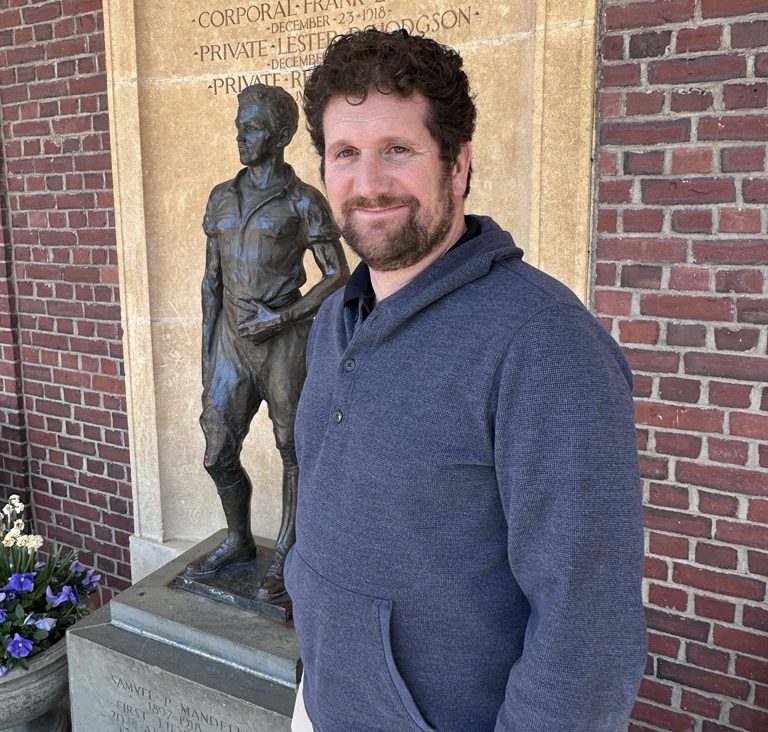
A Life Built to Arrive Here
Perinchief grew up in Bermuda, in a family that has been on the island since 1614. His father was a Rhodes Scholar, and classmates with men like President Bill Clinton, and Admiral Dennis. After being educated stateside, his father returned to Bermuda to practice pediatrics. His mother, Ann, was a member of the first class of nurse practitioners in the U.S., established in 1965 at the University of Colorado. Developed by Loretta Ford and Henry Silver, this pioneering program aimed to expand the role of nurses in primary care, particularly for children. The program was launched in response to a shortage of pediatricians and the need for better access to healthcare . He grew up sailing, scuba diving, and running beaches with sunburned nose, in what he calls, without irony, paradise.
He left at eleven for boarding school in New England, and went straight into the Marine Corps directly upon graduation: military conscription was still standard practice in Bermuda for the local Regiment so if he was not in school, he would have to serve in some capacity regardless. He told his wrestling coach, Wayne Clark, who was a Force Reconnaissance Marine, what he was facing, and the coach had an alternative suggestion. Dave called his parents, and they said OK, this is your choice, and we support it.
After the Marines, after the surgeries, after meeting and eventually marrying Casey, whose sister had gone to boot camp the same summer as Perinchief, and who had sent him care packages from Iraq in 2006, he landed here. Since 2015, he has served as Veterans Agent for the City of Beverly, a role that sounds bureaucratic and operates as something closer to a lifeline.
“I take thousands of pages of laws and rules and arbitrary nonsense and make it make sense for vets and families,” he says. Much of his work involves seniors, veterans in their sixties, seventies, and eighties for whom computers are foreign territory and whose paperwork simply needs someone willing to sit down and do it. “The hidden challenge is technology,” he says. “So I usually wind up doing the paperwork.”
It is unglamorous, essential work, carried out with the same commitment he brought to being a squad leader: you are responsible for the people in your care, and you don’t leave.
The Research
Perinchief brought in Ken McKay, Beverly’s Assistant Veterans Director and a meticulous historical researcher who has spent nearly a decade cataloguing the military history of the region, cross-referencing census records, military records, and genealogies to account for every veteran Beverly has produced, including 500 privateers from the Revolution granted letters of marque to fight the British Navy as what Perinchief cheerfully calls “legal pirates.”
McKay worked the guidon’s history systematically: the stitching where a staff would go through, the painted emblem on what appeared to be silk, the details that placed it far outside the modern era of standardized military manufacturing. The research led to a name: the 1st Regiment Mounted Riflemen, formed in 1846 for the impending Mexican-American War, renamed the 3rd Cavalry Regiment in 1861. The 3rd Cavalry , the “Brave Rifles,” one of the oldest cavalry units in the Army, is based today at Fort Hood, Texas.
Perinchief called Fort Hood and sent photographs. The local museum confirmed it: the guidon was genuine United States Army history, 180 years old. Additionally it was discovered that the frame bore the marking of Veerhoff Galleries, the same Washington atelier that framed the Declaration of Independence.
How a mid-nineteenth century cavalry banner ended up in a Hamilton attic is a question without a definitive answer. Hamilton is horse country. The Patton family has deep roots here. A cavalry officer could plausibly have had connections to this corner of Massachusetts. The flag could have been gifted, inherited, donated, or sold. “This predates technology,” Perinchief observes. “Was it gifted? Donated? Pawned?” The speculation is enjoyable rather than urgent. “The important thing is it belongs with its unit.”
Coming Home
On Saturday, May 17th, at 1:30 in the afternoon, Sergeant Major Billy J. Hendrix , Regimental Operations Sergeant Major of the 3rd Cavalry Regiment , will travel from Fort Hood, Texas to Hamilton to receive the guidon in person. The timing is precise: the presentation will allow the regiment to carry it home for the 180th anniversary of the 1st Regiment Mounted Riflemen’s founding on May 20th, 1846.
The ceremony takes place as part of the 4th Annual Warrior Weekend and Memorial Event , organized by Perinchief and the Beverly Veterans office for the weekend before Memorial Day. That timing is deliberate.
“Memorial Day is not a hot dogs and parade day for people who lost someone in combat,” Perinchief says carefully. “I was there to see people die. That day amplifies those memories.” Warrior Weekend is his answer and gift to the larger community: a regional event to celebrate the sacrifices made by the men and women who never came home, bridge generations, and give communities a way to honor military sacrifice before the holiday arrives.
This year, the guidon ceremony gives the weekend a historical dimension none of them planned for.
Deeper Meaning for The Community House
Elmer sees in the discovery something that speaks to the deepest layer of what The Community House is. The building was constructed in 1921 by George and Emily Mandell in memory of their son Samuel, one of eight Hamilton men killed in World War I. Sam, who died days before Armistice, was buried temporarily in France before his body was brought home. His parents built this place in his memory, a space for community born from grief and the human need to return.
“Just as Sam was able to return home,” Elmer says, “this guidon can also return home. There is always something about the military, about returning home. That notion runs deep.”
Perinchief understands this personally. When he and his wife were searching for a house and she chose Hamilton, he discovered later that his grandmother, Eddie Preston, born here, daughter of a butler on the Clark estate near School Street, had grown up in this town before his grandfather, a Royal Air Force soldier, brought her to Bermuda.
Dave Perinchief, the kid from Bermuda who became a Marine on the eve of September 11th, who fought in two wars and was rebuilt surgery by surgery, had come home without knowing it.
The guidon had been here all along, waiting to do the same.
The guidon ceremony takes place Saturday, May 17th at 1:30 PM as part of Warrior Weekend. For more information, visit https://www.beverlyma.gov/1019/Warrior-Weekend .