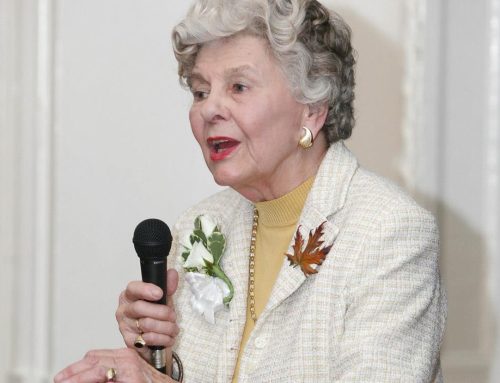
Every year, The Community House pauses to honor one person in the Hamilton-Wenham community whose volunteer service embodies a universal truth that the most powerful thing any of us can give is our time. The Joanne Holbrook Patton Volunteer Award, named for the woman who saved The Community House from closure in 1983 and spent the rest of her life building the community she loved, recognizes a resident whose long-term, uncompensated commitment to this town has quietly shaped it for the better.
This year, that person is Rick Mitchell. He will be presented with the award at the Bloom to Grow celebration on May 7 at The Community House.
A Boy from the Cape
Rick Mitchell was born in Fall River and grew up in Barnstable, on Cape Cod, in a household that taught him early what it means to figure things out on your own. His parents separated when he was four. His mother, Betty, packed up four children and moved in with her parents, and in the years that followed, she became the kind of woman her son still talks about with barely contained admiration.
Betty Mitchell didn’t have a blueprint. She wasn’t a working mother by plan, she became one by necessity, commuting from the Cape to Bridgewater to earn her teaching certification, eventually landing a job at a school for children with special needs, and picking up shifts during the summer at a local Talbots to fill the gaps. She raised her children with a spirit of openness and adventure that Rick absorbed completely. At 83, she accepted a gift from her tenant, a flight on a Russian fighter jet out of Beverly Airport, and spent the ride doing loop-de-loops having the time of her life. Her chosen gravestone inscription: Life is an adventure.
“She was the inspiration that got me here,” Rick says. “She was outgoing, inquisitive, and up for trying new and different things.”
A few blocks from their home was Barnstable Harbor and the Barnstable Yacht Club, really more of a boating club, with no electricity or running water, but a social center that gave Rick something that would stay with him for the rest of his life: sailing. His introduction to the water wasn’t auspicious. At seven or eight, a family sail ended with a broken rudder, a 20-knot wind, and a terrified young Rick hiding under the deck while someone towed them back to the yacht club. He avoided boats for years afterward. Then a local boatyard owner, a man with no children of his own who saw something in the quiet kid, told Rick he could take out a small beetle cat whenever he wanted. Rick finally worked up the courage. He sailed for an hour.
“I thought, oh, I like this,” he says simply. He has never stopped.
The Making of a Civic Mind
Betty remarried and the family moved to Ipswich in 1969. That same year, Rick arrived at Northeastern University as, in his own words, “a naive introvert from Cape Cod”, and landed in the middle of one of the most turbulent moments in American civic history. The Vietnam War protests had made college campuses the center of the national protests, and Boston was no exception.
One spring evening on Hemingway Street, a spontaneous block party drew a thousand students into the road to celebrate on warm spring night. Rick watched the energy shift as the Boston riot police arrived, sensing impending danger Rick found the tactical police captain on the edge of the crowd, learned the street was about to be cleared, and started yelling at anyone who would listen to leave immediately . Nobody listened. The tactical police came in with riot gear and batons swinging. Rick ran into his dorm, ducked into a closet, and had a baton hit him anyway. In the aftermath, he was on the phone to the Governor’s office seeking to prevent a repeat of the event.
“I think that radicalized me,” he says half-laughing, reliving the memory as he speaks, “into thinking: how does this work? How do you communicate to the governing structure? How do you operate within the system to prevent things that shouldn’t be happening?”
That question became the animating force of his adult life.
Building a Life, and a Town
After graduating with a degree in political science, Rick found his footing through a series of moves that can only be described as ‘characteristically Rick’: relentlessly purposeful, refreshingly unorthodox. He traveled the country by Amtrak seeking opportunities in the railroad industry by calling senior executives directly through a person-to-person operator a trick that got him past every secretary in America. When that path closed, he crewed on a custom-built 47-foot ketch up the coast of Maine for a summer because he loved to sail. When he wanted to work in municipal energy efficiency and MAPC had no open positions, he offered to work for free for three months, supported himself with evening shifts at a liquor store, and proved his value until they hired him. Within a year of taking over a newly created energy office for the City of Somerville with no job description and no roadmap, he had landed over two million dollars in grants and won the Governor’s award for outstanding achievement in energy conservation.
His response, standing in the basement with his staff when the call came: “If we’re getting an award in energy efficiency, we’re all in big trouble, because we just started.”
He married Carin in 1992, after spotting her in the backseat of a friend’s car when the two cars stopped abreast at a red light and calling the friend later to ask for her number. She said no. He persisted and the connection was made. They’ve been together ever since. Carin is now in her third term as Hamilton’s Town Clerk. “We’re very much government junkies,” Rick says with a laugh. “Community minded, committed to working within government to improve the community..”
They don’t have children, not by firm decision, but by a quiet, shared understanding shaped by two single parent childhoods. Both learned early to be self-sufficient; neither felt a driving pull toward parenthood. What they found instead was each other, and a community. “We’ve had the luxury of investing our time and energy into other things, perhaps ‘the larger family we are all a part of,” Rick says. “Community service is our passion, and it provides us a connection, an opportunity to interface with people, to work for positive change. It extends the definition of family, with all the personality flavors of any large family.” He laughs again at that.


What He Built in Hamilton
After marrying Rick and Carin moved to Hamilton, and Rick got to work.
He joined the town’s Planning Board and helped craft the master plan in 2002, where he met his friend and eventual award nominator Marc Johnson, helping bring together some 80 residents to help shape Hamilton’s future. He served multiple terms on the Planning Board, where Marc describes him as “a massively rational voice”, patient, practical, never dogmatic, always willing to absorb dissenting feedback and return with a modified proposal rather than dig into a position. “He wasn’t willing to sit back and pontificate,” Marc says. “He wanted to do it.”
Rick helped establish the Hamilton Development Corporation (HDC), funded in part through the meal tax, which gave the town a source of development funding. And then there was the Mac’s Shoe site, a downtown parcel that the HDC believed could become something meaningful for Hamilton’s commercial base and housing supply. For over eight years he and other volunteer HDC board members, crafted a plan, made the case. Patiently and repeatedly, until an $8 million-dollar mixed use project happened. The result: 18 units of market-rate affordable housing and a new bakery downtown, built on one acre, expanding the tax base and bringing new life to the town center.
“If he believes in something,” Marc says, “he puts his hours and manpower behind it. While others pontificate on Facebook, Rick is knocking on doors getting it done.”
What makes Rick genuinely unusual, Marc notes, is something harder to quantify: “he has never once advocated for something that personally benefited him. In decades of public meetings and planning sessions and board deliberations, in a town where everyone tends to show up for their own interests,” Marc observes, “Rick shows up for Hamilton’s.”
Looking Forward
After retiring decided he needed a new challenge and jumped back into local government. Rick is wrapping up his third year as Climate Resiliency Manager for the Town of Ipswich, where he is overseeing a $5 million municipal energy efficiency program. Re-retirement is on the horizon, and with it: more boating, more travel through New England in the RV he and Carin keep, and time to simply breathe.
But even now, the thing on his mind isn’t rest. It’s the next generation.
“Can we nurture and help find and guide the next generation of community leaders?” he asks. Given the current climate, he says, there is a genuine need for capable, competent people to step up. “Our founders created a citizen-led governing structure that relies on its citizens to populate and lead its government. We get the government we deserve. So, if you want better government, you better step up.”
He pauses. “People can have their greatest impact at the community level, working with friends, neighbors, fellow residents. It’s relatively easy to make a positive impact.”
Rick Mitchell has been proving that for over twenty years. The Joanne Holbrook Patton Award, given this year in his honor, could not have found a more fitting recipient.
The Joanne Holbrook Patton Volunteer Award is presented annually by The Community House to a Hamilton-Wenham resident who demonstrates a sustained, long-term commitment to volunteerism and community service. Nominations are open to the public. To learn more, visit communityhouse.org.